
Technical
Acacia Senegal vs Acacia Seyal: Which Gum Arabic Does Your Formulation Need?
Two species share one additive code, one commercial name and almost nothing else where it counts. Choosing the wrong one is one of the most common — and most expensive — reformulation mistakes.
One name, two materials
Gum arabic is defined commercially and legally as the dried exudate of Acacia senegal or Acacia seyal. Both are approved as food additive E414 in the EU, both are covered by the same JECFA specification, and both are correctly labelled "gum arabic" or "acacia gum" on an ingredient declaration.
That regulatory equivalence hides a substantial functional difference. The two species produce gums with different molecular architectures, and the property most affected is precisely the one most formulators buy gum arabic for: its ability to hold an oil-in-water emulsion together.
In Sudan the distinction is a commercial fact of life. Hashab (Acacia senegal) and Talha (Acacia seyal) are traded as separate materials at separate prices. Outside the producing region the distinction is frequently lost in translation — usually to the buyer's cost.
Why senegal emulsifies better
Gum arabic is a complex mixture of polysaccharide and protein. The emulsifying behaviour comes from a minor fraction — the arabinogalactan-protein complex — in which a protein backbone carries large carbohydrate blocks. At an oil–water interface the protein portion anchors into the oil phase while the carbohydrate blocks extend into the water, physically preventing droplets from coalescing.
Acacia senegal carries a higher proportion of this fraction and a higher overall nitrogen content, which is the practical proxy for protein. That is the mechanism behind its stronger emulsification.
Acacia seyal has a lower nitrogen content, a different molecular weight distribution and a higher proportion of the non-emulsifying fraction. It still dissolves, still contributes viscosity and still delivers soluble fibre — it simply does not hold an emulsion as well.
| Property | Acacia senegal (Hashab) | Acacia seyal (Talha) |
|---|---|---|
| Local name | Hashab | Talha |
| Colour in solution | Pale, near-clear | Darker, reddish tint |
| Nitrogen / protein content | Higher | Lower |
| Emulsification | Strong | Weak to moderate |
| Optical rotation | Negative | Positive |
| Viscosity at equal solids | Higher | Lower |
| Soluble fibre | High | High |
| Relative price | Premium | Discounted |
Where the choice actually matters
The decision is application-driven. If the gum is doing interfacial work — holding oil in water — the species matters enormously. If it is doing bulk work — contributing fibre, body or film — the species matters far less.
Beverage emulsions are the clearest case. A citrus oil emulsion stabilised with an under-performing gum will look acceptable on day one and show a visible ring at the neck of the bottle within weeks. By the time the failure appears, the production run has shipped.
Fibre fortification is the opposite case. If gum arabic is being added to a powder blend purely to raise the soluble fibre declaration, the emulsifying fraction is doing nothing, and paying a premium for it is a straightforward waste.
- Specify Acacia senegal — beverage emulsions, flavour encapsulation, spray-dried flavour carriers, confectionery coatings, wine and beverage clarification.
- Acacia seyal is often adequate — soluble fibre fortification, bulk viscosity, some bakery and dry-blend applications, technical and industrial uses.
- Test both — supplement powders, where fibre load matters more than emulsification but taste and dispersion still need checking.
How to tell them apart on arrival
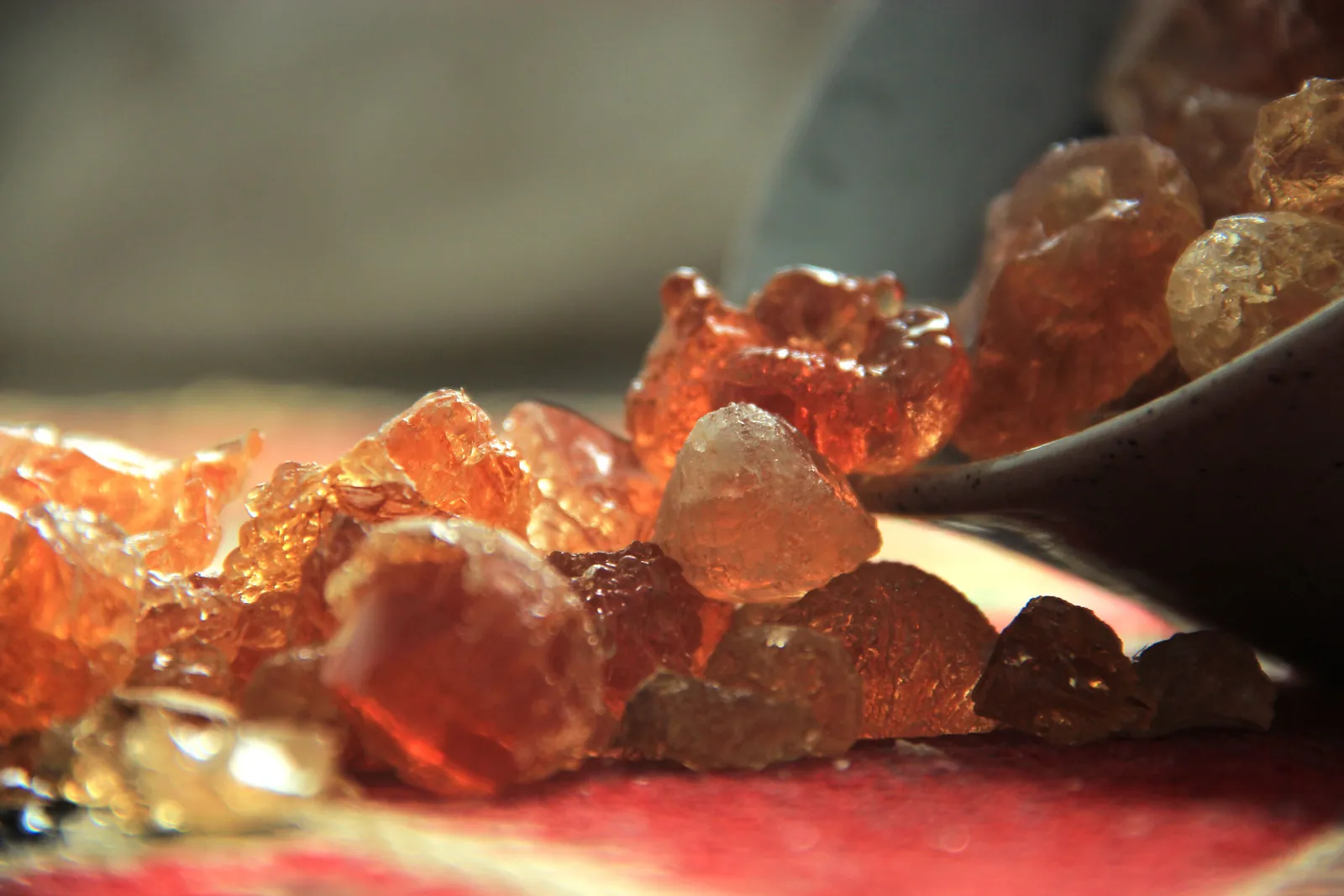
The fastest indicator is colour. Acacia senegal nodules run pale honey to light amber and give a near-clear solution; Acacia seyal is visibly darker with a reddish cast that carries into solution. In a clear beverage, that colour difference alone can be disqualifying.
The definitive laboratory distinction is optical rotation: solutions of Acacia senegal are levorotatory while Acacia seyal is dextrorotatory. Nitrogen content provides a supporting indication, with senegal typically running higher.
For a buyer without laboratory access, the practical protection is contractual: require the species on the quotation, the specification and the Certificate of Analysis, and specify optical rotation as a release parameter.
Beware the blend
Blends of the two species are sold as generic "gum arabic" at a price between the two. A blend is not necessarily a problem — but it is only acceptable if you knew you were buying one.
The price gap and what it is buying
Acacia senegal consistently trades at a premium to Acacia seyal. The gap widens when supply from the Sudanese gum belt tightens, which happens for reasons — weather, harvest, logistics — that are largely outside any supplier's control.
When a quotation for "gum arabic" comes in materially below the prevailing senegal market, the realistic explanations are that it is seyal, that it is a blend, or that the cleaning has been less thorough and the acid-insoluble matter will show it.
None of those makes the material worthless. They make it a different material with a different correct application — and worth knowing about before it arrives on your dock.
Frequently asked questions
Are Acacia senegal and Acacia seyal both legally gum arabic?
Yes. Both species fall within the definition of gum arabic and both are approved as food additive E414 in the EU, so both can legitimately be declared as gum arabic or acacia gum on an ingredient list.
Can Acacia seyal replace Acacia senegal in a beverage emulsion?
Not reliably. Acacia seyal has a lower protein content and a weaker emulsifying fraction, so an emulsion stabilised with it is more likely to separate over shelf life. For emulsion applications, specify Acacia senegal.
What is the difference between Hashab and Talha?
They are the Sudanese trade names: Hashab is Acacia senegal and Talha is Acacia seyal. Hashab is the premium grade with stronger emulsification; Talha is darker and cheaper.
How can a laboratory confirm which species was supplied?
Optical rotation is the standard test — Acacia senegal solutions are levorotatory and Acacia seyal solutions are dextrorotatory. Nitrogen content provides supporting evidence, with senegal typically higher.
The right species is the one your application needs, not automatically the expensive one. The failure mode worth avoiding is not buying seyal — it is buying seyal while believing you bought senegal. Specify the species in writing, require it on the Certificate of Analysis, and the question stops being a risk.
More insights
How to Choose a Gum Arabic Bulk Supplier: A Practical Buyer's Guide
What to verify before placing a bulk gum arabic order — origin evidence, grade, specification consistency, documentation, MOQ and Incoterms. A practical qualification checklist for procurement teams.
RegulatoryImporting Gum Arabic into the Gulf: A Guide to Documentation, Labelling and Shipping Requirements
What Saudi Arabia, the UAE, Qatar, Kuwait, Oman and Bahrain require to clear a gum arabic shipment — regulators, mandatory documents, Arabic labelling rules and the mistakes that hold containers at the port.
Have a question this did not answer?
Send it to our sales desk. If it is a good question we will probably write the next article about it.